You search for the service your firm has been providing for years, maybe decades, and a younger competitor shows up in Google search results ahead of you.
That gets under your skin a little.
Not because you think no one else deserves to be there. It’s because you know the difference between visibility and experience, and in this case, you have more experience.
You’ve been doing the work longer. You’ve built the referral relationships. You’ve earned trust over time. You’ve probably handled more complicated situations, worked with more clients, and learned things that only come from years of actually doing the job.
And yet, there they are.
Higher in the search results. More visible on Google. More reviews. Better photos. A profile that looks current and active.
So the question is obvious:
Why are they showing up first?
The answer usually isn’t that Google thinks they’re better.
It’s that Google may understand them better.
Google Does Not Know Your Reputation the Way Your Market Does
This is where established firms can get caught off guard.
Your reputation may be very clear in the real world.
Other professionals know who you are. Referral partners know what you’re good at. Past clients know why they trusted you. People in your community may have known your name for years.
Google doesn’t have that context.
It works from what it can actually see and understand online.
Google says local search results are primarily influenced by relevance, distance, and prominence, and that complete and accurate business information can improve the chances of appearing in local results. It also notes that reviews and positive ratings can help local ranking.
That sounds fairly straightforward, but the practical implication is easy to miss:
Google cannot give you credit for a reputation it cannot clearly interpret.
You may have 20 years of credibility sitting behind the business, but if your profile is thin, outdated, vague, or incomplete, Google has less to work with.
Meanwhile, the younger competitor may be giving it a very clear picture.
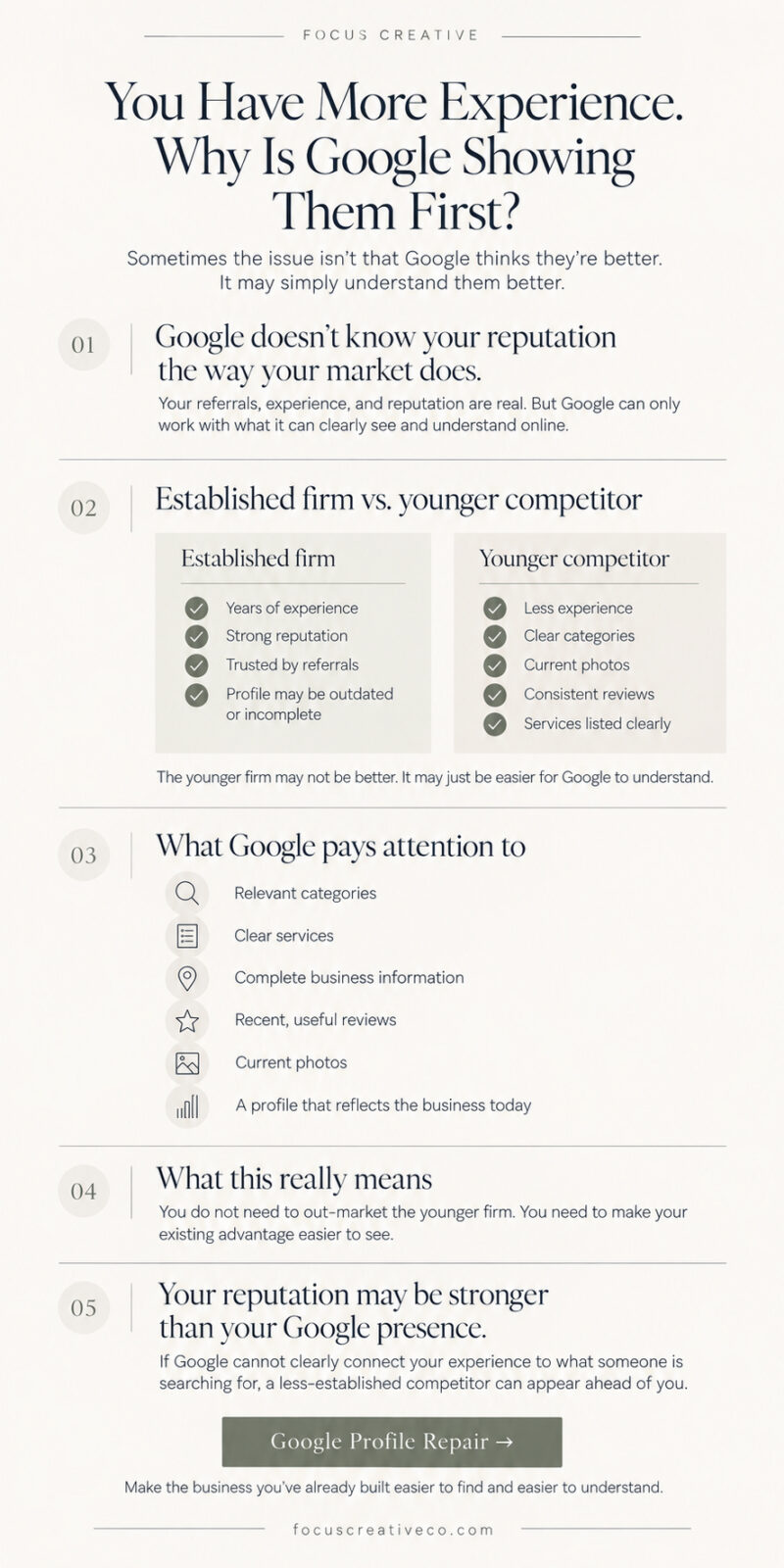
A Younger Firm Can Be Easier for Google to Understand
Picture two firms.
The first has been in business for 25 years. Strong client base. Good reputation. Plenty of referrals.
Their Google profile was set up a long time ago. The main category is broad. Some services are missing. The description is generic. The photos are old. Reviews come in here and there, but no one is really paying attention to the profile.
The second firm has been around for six years.
Its categories are specific. Services are listed clearly. The photos are current. The business information is complete. Reviews come in regularly, and the reviews actually mention the types of problems the firm helps solve.
If you were Google, which business would be easier to understand?
That’s really the point.
It is not deciding which team is more talented.
It is trying to figure out which business is most relevant to the person searching.
And if one firm is sending clearer signals than the other, that matters.
The Firm With More Experience Can Still Look Less Relevant
This is the part I think a lot of established businesses underestimate.
From inside the business, you know exactly why your firm is better qualified.
The person searching does not.
They see what appears in front of them.
They see the Google profile. The number of reviews. How recent those reviews are. The photos. The services listed. The website. The language used to describe the business.
That is what they have to go on.
And that can create a weird gap where the less-experienced firm looks more established simply because it is easier to understand online.
BrightLocal’s 2026 consumer research found that 97% of consumers read reviews for local businesses. It also found that the average consumer now checks six different review sites when choosing a business.
Even more telling, 27% said they had spent more than $1,000 after reading reviews, and 13% said they had spent more than $5,000.
So this is not just restaurant behavior or someone deciding where to get coffee.
People are using online proof to make expensive, high-trust decisions.
That includes professional services.
“But Everyone Around Here Knows Us.”
Maybe they do.
That is a real advantage.
A strong local reputation is valuable because it takes years to build and it is hard for a competitor to copy.
But there is a difference between the people who already know your name and the people who should know your name but don’t yet.
That second group matters.
Someone searching for:
“estate planning attorney near me”
“CPA for business owners”
“wealth management firm near me”
“commercial real estate attorney”
may have no idea who you are.
They are asking Google to narrow the field for them.
If your profile gives Google very little context, you may not even make it into that first round of consideration.
That is what can be so frustrating.
You can be the more established firm and still be almost invisible to the person who would have been a great fit.
Your Google Profile Is Doing More Work Than You Think
A lot of businesses still treat the Google Business Profile like an online business card.
Name. Address. Phone number. A few reviews.
But that profile is often one of the first real impressions a prospective client gets.
Sometimes it is the first impression.
Google uses the information there to understand what kind of business you are, what you do, where you operate, and when your profile may be relevant to a search.
So the details matter.
Your categories matter
The category you choose tells Google what kind of business you are.
If the category is too broad, outdated, or just not the best fit anymore, you are making Google work harder than it needs to.
Your services matter
Your clients do not always search using the same language you use internally.
They search for the problem they need solved.
If your services are clearly listed, Google has more context about when your business might be relevant.
Your reviews matter
Not just the star rating.
The words people use matter too.
What do clients mention over and over?
What services come up?
What do they say about the experience?
Are the reviews recent, or does it look like no one has said anything about the business in two years?
BrightLocal’s 2025 research found that only 4% of consumers said they never read business reviews, and 74% use two or more sources before choosing a local business.
So people are not glancing at a star rating and moving on.
They are looking for reassurance.
Sometimes the Business Has Changed and the Profile Hasn’t
This is another thing I see with established firms.
The business evolved.
The Google profile stayed frozen in time.
Maybe you added a service that now represents a big part of the business.
Maybe you stopped offering something else.
Maybe the team has changed.
Maybe you became known for a niche that was barely on your radar five years ago.
Internally, everyone knows that.
Your clients know it too.
But Google may still be looking at an older version of the company.
That creates a mismatch.
And when the profile no longer reflects the business you are today, it can affect both who finds you and what they understand when they do.
More Reviews Alone Are Not the Answer
It would be easy to turn this into a “you need more reviews” article.
That would be too simple.
Reviews matter, but they are one piece of the picture.
A business can have plenty of reviews and still have the wrong categories.
It can have strong ratings and still leave half its services unlisted.
It can have a beautiful profile and still be inconsistent with the website.
It can have everything technically filled out and still do a poor job of showing what the business is actually known for.
So the goal is not:
Get more reviews.
The goal is to make the profile a more accurate representation of the business you have already built.
That is a different problem.
You Do Not Need to Out-Market the Younger Firm
This matters too.
The answer is not to copy them.
You do not need to start posting every day because they do.
You do not need to become more aggressive, louder, or more promotional.
You do not need to suddenly turn the firm into a content machine.
You just need to stop hiding your advantage.
If you have more experience, make that easier to see.
If you are known for specific work, make that clearer.
If your clients consistently trust you for certain reasons, let those signals show up where future clients are already looking.
That is not about becoming better at marketing.
It is about making sure your digital presence reflects the reputation you already earned.
Search the Way a Prospective Client Would
This is worth doing.
Do not search your firm name.
Search the service.
Search the city.
Search the way someone would if they needed what you do and did not know who to call.
Then look at the firms that show up.
What do their profiles tell Google?
What services are listed?
How current do they look?
What do the reviews say?
What kind of photos are there?
Then look at yours.
Not through the eyes of someone who knows the whole story.
Look at it as if you were seeing the business for the first time.
You may find that the gap is smaller than you expected.
Or bigger.
Either way, at least now you are looking at the thing that actually matters.
Your Reputation May Be Stronger Than Your Google Presence
That is really what this comes down to.
You may already have the advantage.
The experience. The reputation. The referral network. The client history. The expertise.
But none of that helps much in a search if Google cannot clearly connect those strengths to what someone is looking for.
That is why a younger firm can show up ahead of you without actually being better.
They may simply be easier for Google to understand.
And that is something you can fix.
Is Google Seeing the Business You’ve Actually Built?
If your firm has the experience but your Google presence does not seem to reflect it, that is the place I would start.
Our Google Profile Repair is designed for established businesses whose real-world reputation is stronger than what Google currently sees.
We review and repair the core parts of the profile that help Google and prospective clients understand the business more clearly, including categories, services, business information, visual signals, and other foundational details.
The goal is not to make you louder.
It is to make the business you have already built easier to find and easier to understand.
Schedule a 15 Min Call to See If the Google Profile Repair is Right for You →