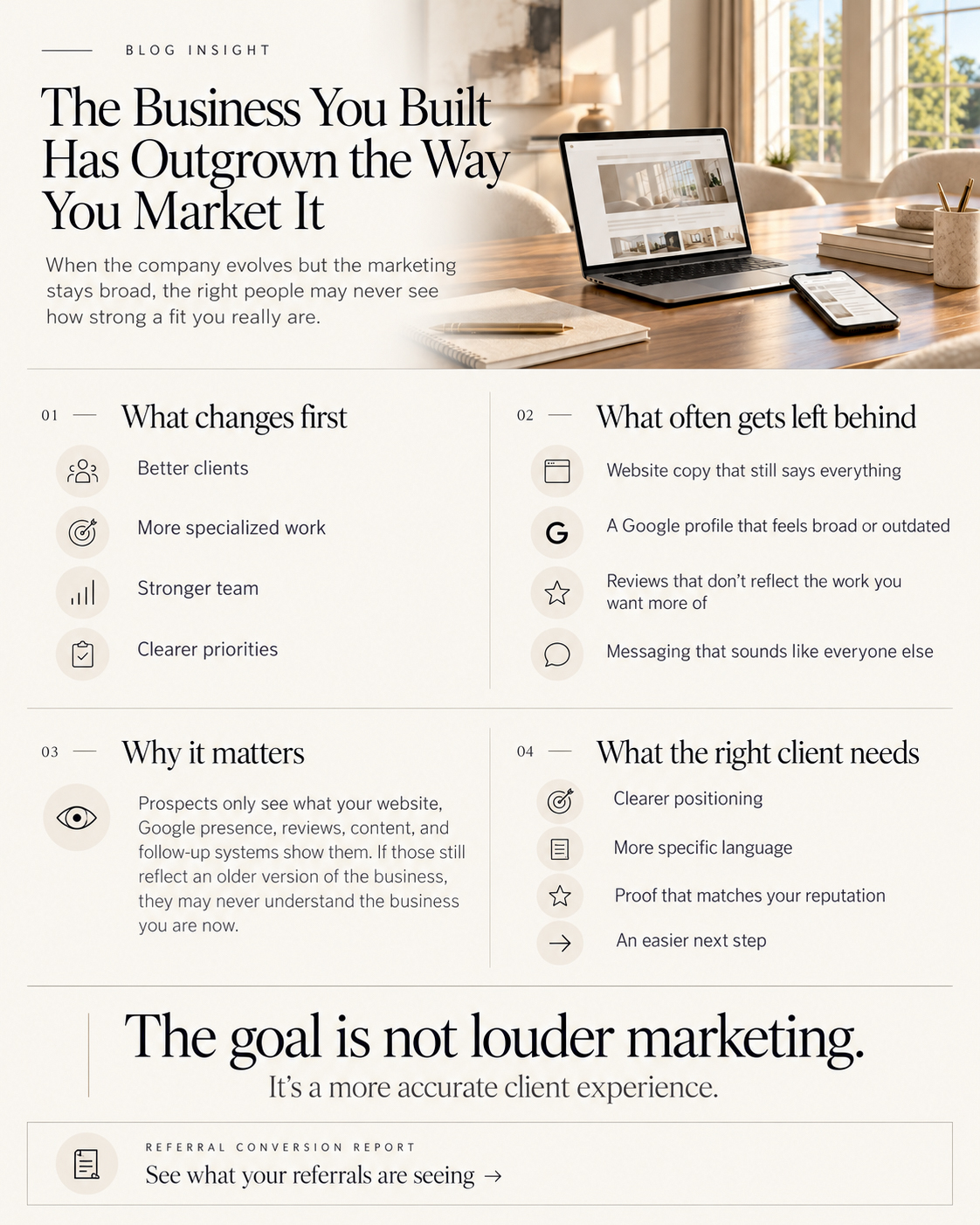
There’s a point in the life of a business where the company you’re running today no longer looks much like the company you started with.
The clients are better. The work is more specialized. The team is stronger. You’ve learned which services are actually worth growing and which ones you’d rather leave behind. You’ve probably raised your standards, your prices, or both.
But the way the business shows up online may still be telling an older story.
Maybe the website was written when you were still trying to explain everything you could do. Maybe the photography is a few years old. Maybe your Google Business Profile still emphasizes services that are no longer a priority. Maybe your reviews are strong, but they do not really reflect the work you most want more of now.
None of that means the business is doing poorly. Usually, it means the opposite. The business grew, but the marketing around it did not grow at the same pace.
And that matters because the people finding you online are not seeing the business from the inside. They are seeing whatever your website, Google presence, reviews, content, and follow-up systems are showing them.
If those things still reflect an older version of the company, they may never realize how strong a fit you actually are.

A Business Can Evolve Without Its Marketing Catching Up
This happens slowly enough that it is easy to miss.
At first, your website may have been perfectly fine for where the business was. Maybe you needed to explain a broad range of services because you were still figuring out which work would become your best work. Maybe referrals did most of the heavy lifting, so the website only needed to exist and look credible.
Then the business became more established.
Certain clients became a better fit. Certain services became more profitable. Your reputation started growing in specific areas. People began referring you for particular problems because they knew where your strengths were.
The business became clearer.
But the marketing often stays broad.
That is when you start seeing things like a website that says everything and nothing at the same time, a Google profile that does not really reflect what you want to be known for, or messaging that could just as easily belong to one of your competitors.
From the inside, you know exactly how the business has matured.
From the outside, someone may not be able to tell.
Your Reputation May Be More Specific Than Your Website
One of the interesting things about businesses built on referrals is that other people often understand the business better than the marketing does.
A referral partner might say, “Call them. They are excellent with complex estate planning.”
A past client might tell someone, “They really understand business owners.”
A colleague might say, “They are the people I trust when the situation gets complicated.”
That kind of reputation has detail.
It has context.
It tells someone why they should pay attention.
Then the prospective client lands on the website and sees something like:
“Full-service solutions tailored to your needs.”
The difference is obvious.
The real-world reputation is specific. The marketing is not.
And when that happens, the person who was referred to you has to do more work to understand why the recommendation was made in the first place.
The Same Thing Can Happen in Google Search
Your Google Business Profile may still describe the business at a surface level even though the company itself has become much more focused.
That can matter for local search because Google is trying to understand what your business does, where you do it, and when it should show you to someone nearby who is searching for help.
If the information is broad, outdated, incomplete, or inconsistent with the work you actually want more of, Google has less context to work with.
The same is becoming increasingly important in AI search.
Someone may ask ChatGPT, Gemini, or another AI tool for a recommendation based on a very specific need. These systems are also trying to understand what your business is known for and whether your online presence supports that conclusion.
If the business has evolved but the digital presence has not, you may still be getting represented as the older, more generic version of yourself.
That can be especially frustrating for established professional services firms because the expertise is already there. The reputation is already there. The market just may not be seeing it clearly enough.
Better Clients Usually Require More Clarity
Most established businesses are not trying to attract everyone.
They are trying to attract more of the right people.
That usually means better-fit clients, higher-value work, stronger relationships, and more of the services the business actually wants to grow.
The more selective the business becomes, the less useful broad marketing becomes.
If someone has to dig through your website to figure out whether you handle their problem, they may move on.
If the service you most want more of is buried under ten other things, they may never realize it is a priority.
If your best clients tend to have a certain kind of need but your messaging still speaks to everyone, the right person may not recognize that you are talking to them.
That does not mean the marketing needs to become louder.
It usually means it needs to become more accurate.
The strongest marketing for an established business is often the kind that makes the right person think, “This feels like it was written for someone like me.”
Your Team Should Not Have to Explain the Business From Scratch Every Time
Another sign the marketing has not kept up is how much explaining has to happen once someone finally reaches out.
If your team regularly has to spend the first part of a conversation clarifying what you actually do, who you are best suited to help, what makes your firm different, or why your experience matters, then the online experience may not be doing enough before the call.
The goal is not for the website to replace the conversation.
The goal is for the conversation to start further along.
A prospective client should already understand the basics. They should already have some confidence in the firm. They should already have a sense of whether they are in the right place.
That makes the conversation easier for them and for your team.
It also means the people who do reach out are more likely to be the people you actually want to talk to.
An Older Marketing System Can Quietly Cost You Good Opportunities
This usually does not show up as one dramatic problem.
It shows up in small moments.
A referral checks the website and keeps comparing.
A strong prospect cannot immediately tell whether you handle their situation.
Someone searches for a service you are excellent at and sees a competitor first.
A person likes what they see but cannot figure out what to do next.
A team member spends time answering the same basic questions over and over.
None of these things feel catastrophic on their own, which is why they can stay in place for a long time.
But over time, they affect who finds you, who understands you, who feels confident enough to reach out, and how much work your team has to do to move someone forward.
That is where the marketing starts to matter less as promotion and more as part of how the business actually functions.
You Probably Do Not Need to Start Over
When business owners notice that the marketing no longer reflects the company, the instinct is often to assume the answer is a full rebrand, a new website, or a much bigger marketing effort.
Sometimes that is the right move.
Sometimes it is not.
The more useful question is whether the experience people have online still matches the business you are running today.
Ask yourself:
- Does the website reflect the work you want more of?
- Does your Google presence make it clear what you do?
- Do your reviews reinforce the reputation you have already built?
- Does your messaging help the right client understand why you are worth considering?
- Does someone know what to do next once they decide they are interested?
Those are the questions that matter first.
Because the goal is not to change the business.
It is to make sure the outside world can see the business you already built.
The Marketing Should Catch Up to the Reputation
For an established professional services firm, the job is not to manufacture credibility.
You already have the experience.
You already have the client history.
You already have the relationships.
You already have the reputation.
The marketing should help make all of that easier to see, understand, and act on.
When it does, the website, Google presence, reviews, content, CRM, email, and intake stop feeling like separate marketing projects and start working together as part of the client experience.
The business feels more consistent from the outside.
The right people understand you faster.
Your team has to explain less.
And the digital presence starts to reflect the caliber of the business you are actually running now.
Want to Know What Your Referrals Are Seeing?
If your business has grown and changed over the years, but you are not sure whether the experience people have online has kept up, that is exactly what the Referral Conversion Report is designed to uncover.
We look at what happens from the moment someone gets your name through the point where they decide whether to contact you. That includes what they find in Google search, what your website communicates, the proof they see, and how easy it feels to take the next step.
If referrals are hearing great things about you but still not reaching out, this can help show you where they may be losing confidence along the way.