If you’ve built a successful law firm primarily through referrals, there’s a good chance you have a pretty healthy skepticism around marketing.
And honestly, that makes sense.
The best firms I’ve been looking at didn’t build their reputations because they figured out how to game an algorithm or put their face on every billboard in town. They built them through years of doing good work, getting results, building relationships, and becoming the attorney other people trust enough to recommend.
That kind of reputation is incredibly valuable, and I’m not going to tell you referrals suddenly don’t matter because everything is “digital” now. They absolutely do.
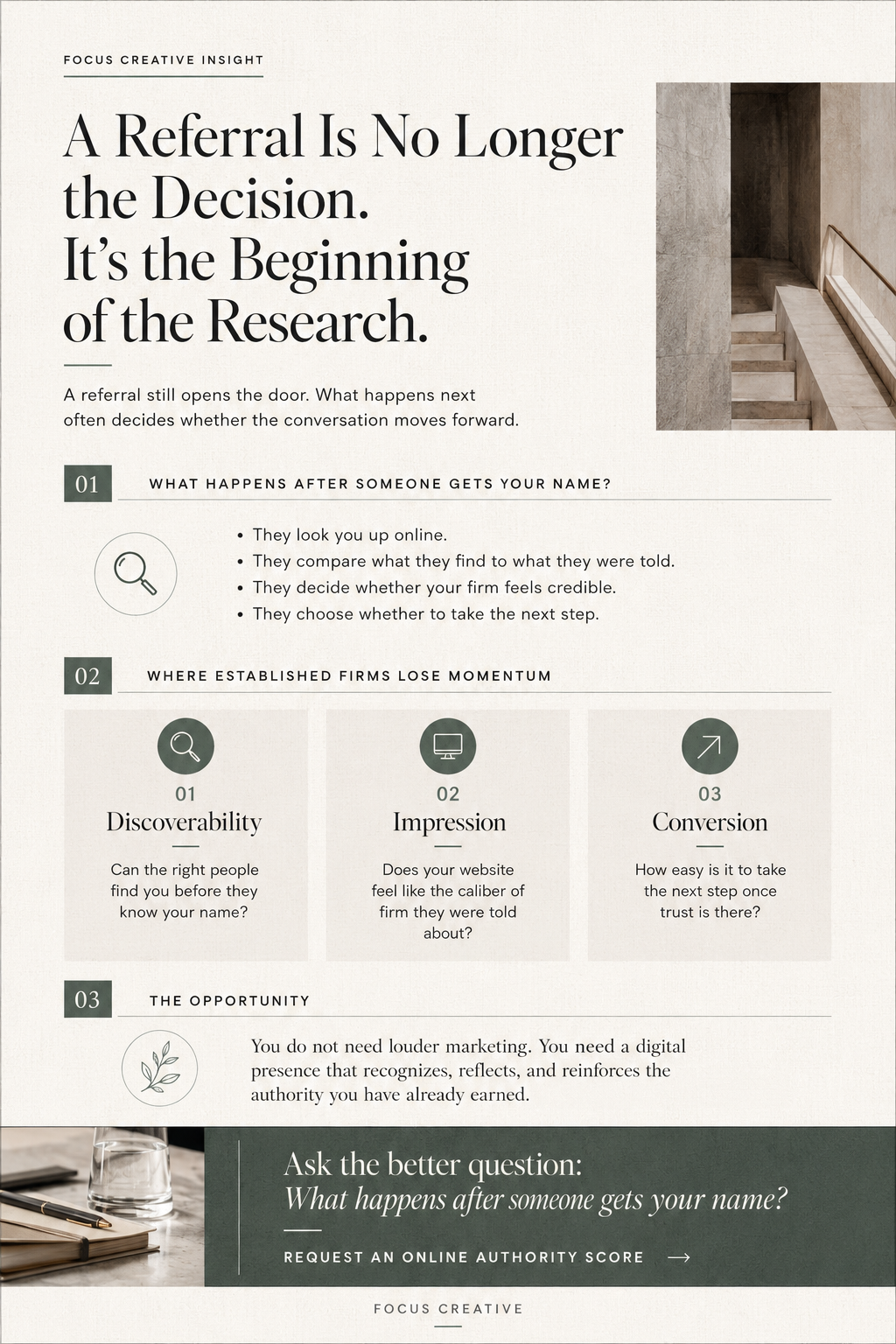
What has changed is what happens after someone gives a prospective client your name.

Think about the last time someone recommended a professional to you. Maybe it was a financial advisor, physician, accountant, contractor, or even a restaurant. There’s a pretty good chance you pulled out your phone and looked them up before you ever made contact.
You probably weren’t doing that because you didn’t trust the person who recommended them. You were filling in the rest of the picture.
Who are they? What do they specialize in? Do they seem established? What do other people say about them? Does what I’m seeing make me feel more confident about moving forward?
Your prospective clients are doing the same thing.
So while a referral may still be the reason someone first hears your name, it’s no longer safe to assume that referral is the entire decision.
Your Best Cases May Still Come From Referrals. What Happens After Someone Gets Your Name?
This is where I think a lot of established firms underestimate the role their digital presence is already playing.
Imagine another attorney tells someone, “You need to call this firm. They’re one of the best in Mobile for this type of case.”
That is a strong introduction. Before the prospective client has even met you, someone they trust has transferred some of their own credibility to your firm.
Then that person searches for you.
Maybe they type your firm name into Google. Maybe they search for one of your attorneys. Maybe they start looking at firms that handle a specific type of case. Increasingly, they may also ask an AI-powered search tool a much more conversational question about who handles that kind of matter in their area.
However they get there, the next part of the decision is happening online.
And now they’re looking for confirmation.
Does this firm actually handle the kind of case I have?
Do these attorneys seem experienced?
Do they have the kind of results and background I was told about?
Does this look like a firm I would trust with something this important?
If the answer is yes, the referral gets stronger.
If what they find is vague, outdated, difficult to navigate, or completely interchangeable with every other firm in the market, the recommendation didn’t disappear, but now there’s a little friction where there wasn’t any before.
In a high-trust decision, that matters.
A Strong Reputation Doesn’t Automatically Become Strong Digital Authority
This is the part that can be easy to miss when the firm itself is doing well.
The phone still rings. Referrals still come in. People in the legal community know who you are. The website technically works.
So nothing feels obviously broken.
But there can still be a significant difference between the reputation your firm has earned in the real world and the authority someone experiences when they encounter you online.
We call that the Authority Gap.
And for an established law firm, it usually shows up in three places:
Discoverability. Impression. Conversion.
Those three things tell us whether the reputation you’ve already built is actually being translated into the digital world.
Can the Right People Find You Before They Know Your Name?
This is the Discoverability piece.
If someone searches your exact firm name, you’ll probably show up.
But that’s a very different question from:
Can someone find you when they don’t know who to look for yet?
Someone may not search for your firm. They may search for:
“personal injury lawyer in Mobile”
“attorney for catastrophic injury case”
“best medical malpractice lawyer near me”
or ask an AI tool something more conversational like:
“Who are the most experienced attorneys in Mobile for a serious injury case?”
That’s where SEO becomes much more important than simply “ranking higher on Google.”
The real job of search optimization is helping Google, AI-powered search tools, directories, and prospective clients understand who you are, what you’re especially good at, where you practice, and why your firm is credible.
That requires more than repeating keywords on a page.
Your practice-area pages, attorney bios, case experience, reviews, local presence, website structure, and the way your expertise is described all help create that picture.
We’ve seen established firms with decades of experience and significant professional recognition barely appear when the search changes from the firm’s name to the problem the prospective client is actually trying to solve. Meanwhile, firms with less experience may show up prominently because they’ve done a better job translating their authority into information search engines can understand.
That doesn’t mean the other firm is better.
It means they’re easier to find.
And those are two very different things.
When Someone Finds You, Does It Feel Like the Firm They Were Told About?
This is Impression.
And for a referral-driven firm, I think this may be the most overlooked part of the entire process.
If someone has just been told:
“These are serious attorneys. They’ve handled some incredibly important cases.”
They naturally form an expectation.
Then they land on your website.
If the photography is ten years old, the design feels dated, the attorney bios sound like resumes, the practice areas are vague, and there’s very little that communicates how the firm actually thinks or works, the prospect has to reconcile two different experiences.
The firm they heard about sounded exceptional.
The firm they found online looks… fine.
That doesn’t necessarily make them think you’re a bad lawyer.
It just creates hesitation.
And that’s why the goal of a better law-firm website isn’t to make the firm look flashier.
It’s to make it look accurate.
The same caliber.
The same professionalism.
The same confidence someone would feel if they were sitting across the table from you.
This is also becoming increasingly important as search changes. Search engines and AI tools need clear, credible information in order to understand what your firm should be associated with. Prospective clients need that same information for a different reason: they need to understand why they should trust you.
Good digital authority serves both.
Once the Right Person Finds You, How Easy Is It to Take the Next Step?
This is Conversion.
And no, I’m not talking about turning your law-firm website into an aggressive online sales funnel.
For an established professional-services firm, conversion is often much simpler than that.
It’s removing unnecessary friction.
Can someone quickly understand whether you handle their kind of matter?
Is the next step obvious?
Does the site work well on a phone?
Can another attorney easily figure out how to refer a case?
What happens after someone submits an inquiry?
Does your team have to chase down information manually, or is some of that qualification happening before the attorneys ever need to get involved?
A good digital system shouldn’t just make the firm look better. It should make the business easier to interact with.
And ideally, that means more of the right opportunities make it through while your attorneys spend less time dealing with the wrong ones.
You Don’t Need More Leads Just for the Sake of Having More Leads
This is another place where I think traditional legal marketing gets the conversation wrong.
A successful firm may not need hundreds of additional inquiries.
In fact, that might make the business worse.
More phone calls, more bad-fit cases, more time spent sorting through people you were never going to represent in the first place.
That isn’t growth. That’s noise.
The better goal is more of the right opportunities.
If your firm has particular experience in catastrophic injury cases, high-value estate matters, complex litigation, or another specialized area, your digital presence should make it easier for the people who need that specific expertise to understand that your firm may be the right fit.
That can affect more than your marketing numbers.
Over time, it can help shape the kind of work the firm becomes known for, the types of matters that reach you, and where your attorneys spend their time.
And when lawyers are spending more of their time on the kinds of cases they are particularly good at handling, that’s good for the firm and potentially very good for the clients who hire them.
And No, This Doesn’t Mean Becoming the Loudest Lawyer in Town
I think this is where a lot of respected attorneys pull away from marketing altogether.
They look around at what “successful legal marketing” seems to mean and think, I don’t want any part of that.
Billboards everywhere. Aggressive television commercials. Manufactured social-media personalities. Generic articles written for search engines instead of actual people. An endless race to be louder than the firm down the street.
If you’ve built your reputation on substance, that kind of marketing can feel completely at odds with who you are.
But those aren’t your only two choices.
You don’t have to choose between being invisible online and becoming a billboard attorney.
There’s a very big middle ground where a firm can be easier to find, easier for search engines and AI tools to understand, more credible when someone lands on the website, and much clearer about what it does—without becoming louder or less sophisticated.
That’s the opportunity.
The goal isn’t to manufacture authority.
You already have it.
The goal is to make sure the digital version of your firm actually reflects it.
Your Digital Presence Should Make the Referral Feel Even Stronger
When someone receives your name from a respected colleague, looks you up, and lands on your website, there shouldn’t be a disconnect between the firm they heard about and the firm they see on the screen.
Ideally, they should think:
Of course. This makes sense.
The website looks like the caliber of firm they expected. The attorneys feel credible and human. The work you’re best known for is obvious. Search results reinforce what they heard. Taking the next step feels natural.
And if they encounter your firm for the first time through Google, an AI search tool, or another online source, the same thing should be true.
They should be able to understand why your firm has the reputation it does.
That isn’t flashy marketing.
It’s making the authority you’ve already earned visible.
So, Are Referrals Still Enough?
I actually think that’s the wrong question.
Your referral network may be one of the most valuable assets your firm has built, and I wouldn’t want to replace it with a pile of anonymous internet leads even if I could.
The better question is:
What happens after someone gets your name?
If a great referral searches your firm tonight, does what they find make that recommendation feel even stronger?
Can Google and AI-powered search tools clearly understand what your firm should be known for?
Does your website accurately represent the caliber of the attorneys behind it?
And if another attorney sends someone your website, are you genuinely proud of the link they’re sending?
Because that’s the standard I think established firms should be holding their digital presence to.
You don’t need the internet to create a reputation for you.
You need it to recognize, reflect, and reinforce the one you’ve already earned.