If you run an established professional services business, there’s a good chance the phrase “we can help you generate more leads” doesn’t immediately get your attention.
In fact, it might have the opposite effect.
You may already have plenty of inquiries coming in. Your team may already be busy. Your calendar may already be full enough that the thought of adding even more people to the top of the funnel sounds less like growth and more like another problem to manage.
So when someone tells you that your business needs “more leads,” your first reaction might be:
We don’t need more leads.
And honestly, you may be completely right.

The real opportunity for an established, reputation-driven business often isn’t creating more volume. It’s making it easier for more of the right people to find you, understand why you’re a fit, and move forward without creating unnecessary work for your team.
That’s a very different marketing problem.
More inquiries don’t automatically mean better growth
Lead volume is easy to measure, which is probably one reason marketers love talking about it.
More website visitors. More calls. More form submissions. More people entering the CRM.
Those numbers can look great on a report, but they don’t necessarily tell you whether the business itself is getting stronger.
Because somebody still has to deal with all of those leads
Every inquiry requires some amount of attention.
Someone has to answer the call, respond to the email, figure out what the person needs, determine whether your business can actually help, gather information, explain the next step, and decide whether the conversation should continue.
If most of those people aren’t a fit, “more leads” can quietly turn into more administrative work, more distractions, and more time spent on conversations that were never going anywhere in the first place.
That’s not necessarily a marketing win.
Sometimes it’s just more noise.
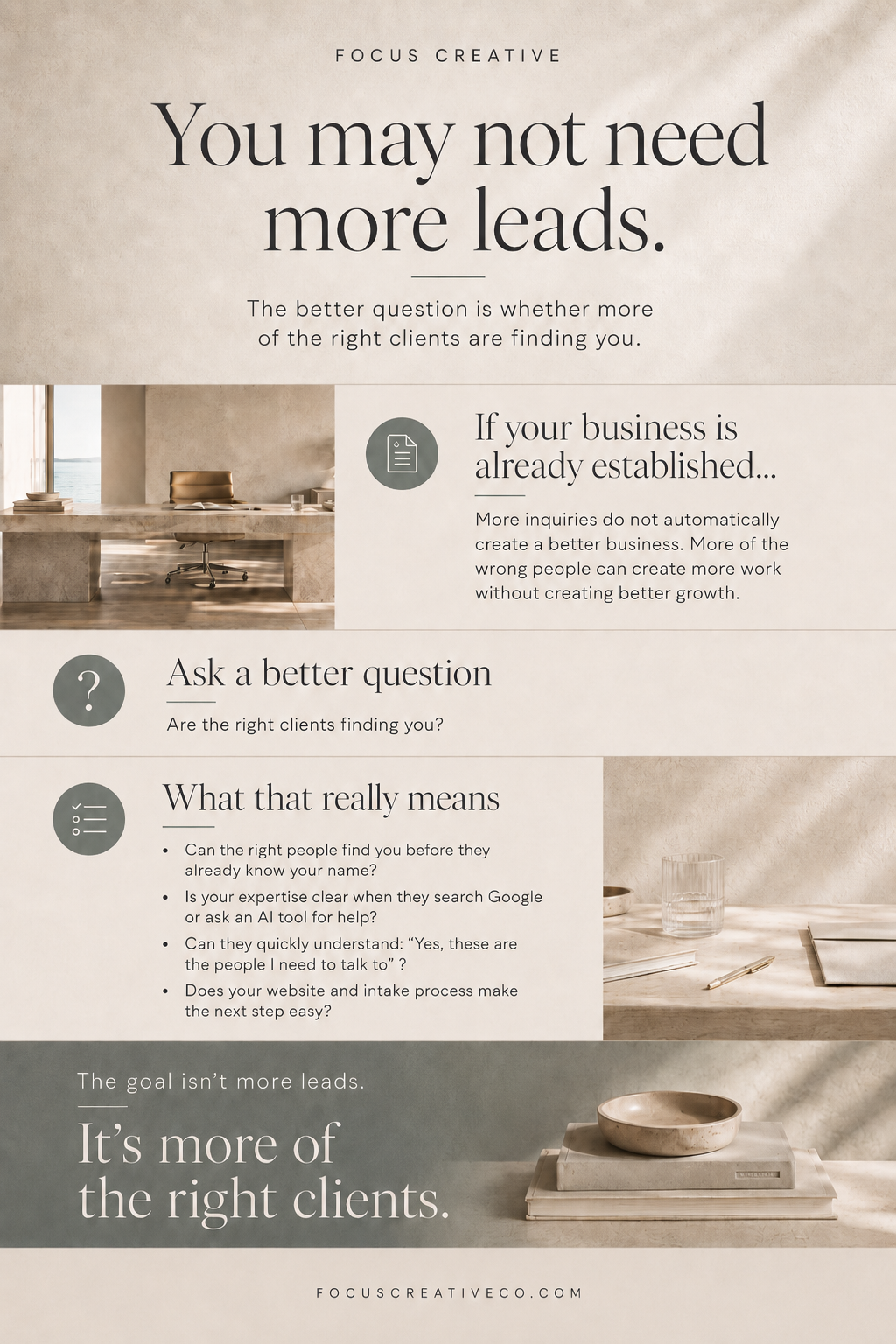
A better question is: how many of the right people are reaching you?
Instead of asking:
How many leads did we generate?
An established professional services business may be better served asking:
How many of the people reaching out are the kinds of clients we actually want?
That shift sounds small, but it changes almost everything about the way you think about marketing.
Think about the clients you would gladly clone
Most successful firms can name them pretty quickly.
They’re the clients who are a natural fit for your expertise. They understand the value of what you do. The work is interesting, profitable, productive, or particularly well aligned with the direction you want the business to grow.
And chances are, those clients have more in common than you realize.
Better-fit clients often lead to better work
If your team has deep experience solving a particular type of problem, it makes sense that you’re often able to create more value when you’re working in that area.
An attorney may do their best work on a particular type of matter. A financial advisor may be especially strong with business owners approaching a transition. A physician may have a specialty where years of experience make an enormous difference. A consultant may consistently create the strongest outcomes for a particular type of company.
Of course, no marketing strategy can guarantee an outcome.
But the closer the client’s needs are to the work your business is especially good at doing, the more opportunity there is for your expertise to actually matter.
So the goal shouldn’t simply be to get more people through the door.
The better goal is to help more of the people you are exceptionally well suited to serve find their way to you.
And that starts before they ever contact you.
Can the right client find you before they know your name?
A lot of established businesses are very easy to find online if someone already knows exactly what to search.
Type the company name into Google and there it is.
But that’s not the same thing as being discoverable.
Your future best client may not know your name yet. They know the problem they’re trying to solve.
They’re searching for the problem, not necessarily for you
Someone may search Google for a specific service. They may describe what’s happening in their own words. Or increasingly, they may ask an AI-powered search tool a complete question about who they should talk to.
They might ask:
Who helps business owners with this kind of transition?
What type of professional do I need for this problem?
Who specializes in this near me?
That’s where SEO starts to become more useful than simply trying to “rank higher.”
Good search strategy for a professional services business should help Google, AI search tools, and prospective clients understand what you are particularly good at, who you serve best, and where your expertise is strongest.
That takes more than adding keywords to a page.
It means being clear about your specialties, your experience, the kinds of problems you solve, the people you solve them for, and why your perspective is credible.
Generic positioning makes the right client work too hard
A lot of professional services websites say some version of:
We provide personalized solutions tailored to your unique needs.
That may be true, but it doesn’t help the right person recognize that they’ve found the business they’ve been looking for.
If your best future client lands on your website, they shouldn’t have to decode what you do or wonder whether you work with people like them.
They should be able to think:
This sounds exactly like my situation.
That’s what strong discoverability and positioning can do together.
Being found is only the beginning
Once the right person discovers you, the next question is whether what they find makes them more confident.
This is where a lot of established businesses lose more ground than they realize.
The business may be excellent. The reputation may be strong. The client experience may be exceptional.
But the digital version of the business doesn’t always make that obvious.
Your website should help the right people self-select
A strong website does not need to persuade everyone.
Actually, trying to appeal to everyone is often what makes professional services websites feel so vague in the first place.
The better job is to help the right person recognize themselves.
They should be able to understand who you work with, what you’re especially good at, how you think about the problem, what makes your approach different, and whether they feel like the kind of client your business is built to serve.
That clarity works both ways.
The right person thinks:
Yes. This is exactly what I need.
And someone who isn’t a fit may realize:
This probably isn’t for me.
That’s not a loss.
That’s qualification happening before your team ever spends time on the conversation.
The goal is to make the first conversation better
This is also where I think the traditional idea of “conversion” gets a little strange for professional services.
When people hear the word conversion, they often picture aggressive sales funnels, pop-ups, countdown timers, and other tactics that don’t feel remotely appropriate for a high-trust business.
That isn’t what we mean.
For professional services, conversion is usually much simpler.
Give the right person a clear path forward
If someone already believes you may be the right fit, what do they need before they feel comfortable reaching out?
Maybe they need to understand your process.
Maybe they want to know who they’ll be working with.
Maybe they need to see evidence that you’ve handled situations similar to theirs.
Maybe they need to know what happens after they fill out the form.
Maybe they were referred by another professional and need a clear way to make that introduction.
A thoughtful digital experience can answer a surprising number of those questions before the first conversation ever happens.
So by the time the right person reaches your team, they’re not starting from zero.
They already understand more about who you are. They’re more confident about why they’re there. And ideally, they’re a much better fit.
That’s a better first conversation for everyone.
Automation should remove friction, not remove the human relationship
The word automation can make professional services businesses nervous, and understandably so.
Nobody wants their clients feeling like they’re being processed by a machine when the entire value of the business is built around judgment, expertise, and trust.
But there’s a difference between automating the relationship and automating the repetitive steps around it.
Let technology handle the parts that don’t require your expertise
Depending on the business, there may be plenty of early-stage work that does not need to consume partner or staff time.
Basic information can be collected before a call. Inquiries can be routed to the right person. Confirmation and next-step instructions can be sent automatically. Scheduling can happen without an email chain. Follow-up can be built into the system. Obvious poor fits can sometimes be filtered before they ever reach a senior person on the team.
None of that replaces the human conversation.
It simply means your people spend more time doing the work that actually requires them.
And for a busy professional services business, that can be incredibly valuable.
You may not need a bigger funnel at all
This is where the usual marketing conversation starts to fall apart for established firms.
Someone looks at the business and immediately assumes the answer is to pour more people into the top of the funnel.
But what if the problem isn’t the size of the funnel?
What if the opportunity is to make the whole journey more selective?
Fewer wrong people. More right people.
Better discoverability helps the right people find you.
A stronger first impression helps them understand why you may be the right fit.
A clearer conversion process makes it easier for qualified people to move forward without creating unnecessary work for your team.
Now marketing isn’t just increasing demand.
It’s helping shape who reaches the business, what they understand before they arrive, and how prepared they are when the conversation begins.
For a business that already has a strong reputation, that’s usually much more useful than simply making the phone ring more often.
Your digital presence can shape what the business becomes known for
There’s another part of this that I think established firms often overlook.
Marketing doesn’t only reflect the business you have today.
It can also reinforce the business you want to become tomorrow.
What would you actually like more of?
Maybe there’s a specialty where your team consistently does its best work.
Maybe there’s a type of client you particularly enjoy working with.
Maybe there’s a service that is more profitable, more interesting, or more strategically important to the future of the business.
Maybe you’ve evolved, but your website still represents what the business looked like five years ago.
Your digital presence can help close that gap.
You can make the services you want to grow more prominent. You can publish deeper content around the subjects you want to be known for. Your case studies, photography, video, bios, and thought leadership can all reinforce the areas where your expertise is strongest.
Over time, that creates a clearer picture of what your business is known for.
And the clearer that picture becomes, the easier it is for the right client to recognize that they belong there.
AI search makes that clarity even more important
Traditional search often revolved around short phrases and keywords.
AI-powered discovery is making search far more conversational.
People can explain what is happening, describe what they need, and ask for recommendations based on much more specific circumstances.
For professional services businesses with real expertise, that can be a huge opportunity.
But there is one catch.
Your expertise has to exist somewhere online
Your team may have decades of experience solving a very particular type of problem.
Your referral partners may know that. Your past clients may know that. Everyone in your professional circle may know exactly what your business is best at.
But if your website barely communicates it, search engines and AI tools have very little context to work with.
That’s why good SEO and AI visibility shouldn’t be about producing piles of generic content just to keep feeding an algorithm.
It should be about making your actual expertise easier to understand.
What do you know?
Who do you help?
What problems do you solve especially well?
What have you learned from doing this work?
What makes your point of view different?
The clearer those answers become online, the more useful your digital presence becomes to both people and the systems helping them decide who to trust.
So no, you may not need more leads
I think that objection deserves a lot more respect than it usually gets.
If the business is already successful, your team is busy, and referrals are consistently bringing work through the door, simply increasing lead volume may not improve anything.
But that doesn’t mean there’s no opportunity.
It may just mean you’re asking the wrong question.
Instead of:
How do we get more leads?
Ask:
How do we help more of the right clients find us?
Can they find you before they know your name?
Can they tell what you’re especially good at?
Does what they see online make them more confident?
Can they quickly determine whether they’re a good fit?
Can they take the next step without creating unnecessary work for your team?
And is your digital presence helping you become more visible for the work you actually want more of?
Those are much more useful questions for a reputation-driven business.
More isn’t the goal. Better is.
You don’t need every person searching for a professional like you.
You need the right person to find your business and recognize:
These are the people I need to talk to.
That’s what a strong digital presence should help accomplish.
More of the right clients. Better-fit work. Stronger client outcomes. Less wasted time. And more room for your team to focus on the work it does best.
That’s a much more valuable goal than simply generating another lead.
How Easy Is It for the Right Client to Find and Choose You?
If you’re wondering whether the right clients can actually find you, whether what they see reflects the reputation you’ve built, and how easily they can take the next step, that’s exactly what our Authority Score is designed to show you.
We review your digital presence across three areas:
Discoverability — Can the right people find you before they already know your name?
Impression — Does what they find reinforce the reputation you’ve earned?
Conversion — Is it easy for the right client to move from interest to conversation?
You’ll get a clear look at where your digital presence is already working, where there may be an Authority Gap, and what opportunities are worth paying attention to next.
Request Your Authority Score →
I’d use this CTA—or a close variation of it—at the end of every blog going forward, but tailor the first sentence to the article so it never feels pasted on.