Ask an established attorney who the real competitors are in his market, and he probably has an answer before you finish the question.
A custom home builder knows which other builders tend to show up on the same shortlists. A physician knows the other practices patients usually compare. A financial advisor knows which firms serve a similar type of client.
Inside the industry, the competitive landscape feels pretty clear.
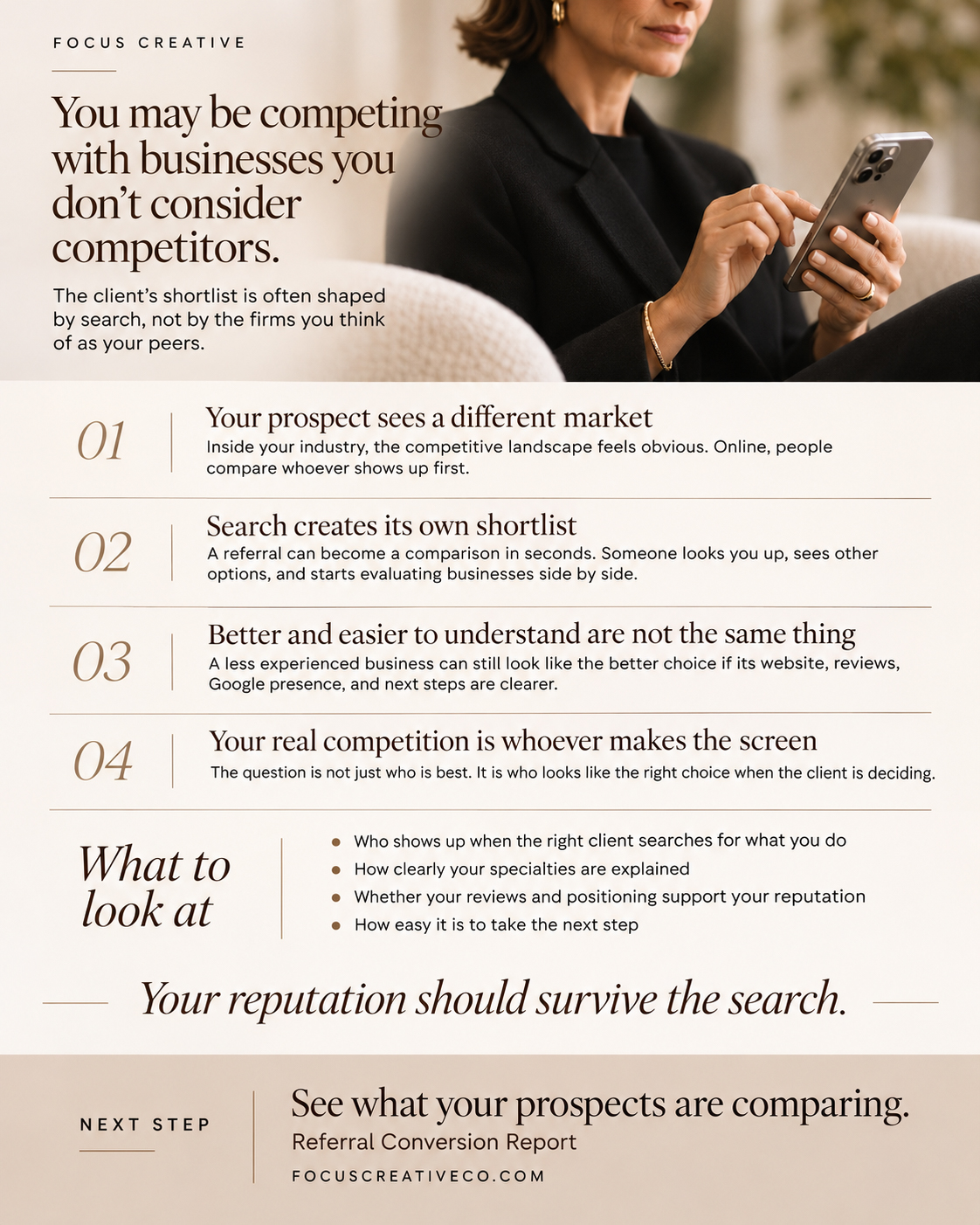
But that may not be the competitive landscape your prospective client sees.
Someone searching online does not have the same context you do. They may not know who has been doing the work for 20 years, who other professionals trust with the difficult matters, who has built a reputation around a particular specialty, or who is considered one of the strongest choices in the market.
They see whoever shows up.
And in a matter of minutes, that can create a completely different shortlist.

Your Prospect May Be Comparing You With a Business You Would Never Compare Yourself To
Take an established personal injury firm in Alabama.
The attorneys have decades of experience. They have been recognized by organizations like Super Lawyers. They are known for serious litigation and are willing to take difficult matters all the way through trial when that is what the client needs.
Inside the legal community, those distinctions matter.
Other attorneys understand that not every personal injury practice operates the same way. Some firms are built to handle a very high volume of matters. Others are more selective and devote substantial resources to complex litigation and trial work.
Those can be very different practices serving very different clients.
But the injured person searching for a lawyer may not understand that distinction yet.
They might search Google for a personal injury lawyer in Birmingham, an Alabama trial lawyer, or an attorney for a serious injury claim and see several firms sitting beside one another on the same screen.
To that person, they may all look like comparable options.
That is where the real competition starts.
Not necessarily with the firms you consider your peers.
With the businesses the prospective client has been given to compare.
A Referral Can Become a Competition in About 30 Seconds
This is especially important for businesses that have always relied heavily on referrals.
Someone says, “You should call this firm. They’re excellent.”
That recommendation still carries a lot of weight.
But it often does not lead directly to the phone anymore.
The person usually looks the business up first.
They search the name on Google. They look at the reviews. They click through to the website. They may check Facebook, LinkedIn, Instagram, or whatever appears in the search results.
And while they are doing that, they are exposed to other options.
What began as:
“I was told to call this firm.”
can quickly become:
“Let me see who else is out there.”
The referral source chose you.
Search may give the prospect another shortlist.
And that shortlist may include businesses with a very different level of experience, specialty, reputation, or business model.
The prospective client does not know that yet.
Search Creates Its Own Competitive Set
This is one of the biggest changes established professional services businesses have had to adapt to.
For years, reputation largely determined who got considered.
Someone asked a friend, colleague, physician, attorney, neighbor, or business associate for a recommendation. A few trusted names came up, and the client started there.
That still happens.
What changed is what happens next.
Google, local search, social media, reviews, and increasingly AI-powered search now help shape the list the client evaluates.
A prospective client may begin with one recommendation and end up looking at four businesses.
A person searching for a lawyer in Mobile, a builder in Fairhope, a financial advisor in Baldwin County, or a specialist in Pensacola can see options instantly, whether those businesses are truly comparable or not.
The search engine is not explaining the nuances.
It is not saying:
“This business has twice the experience.”
“This firm is known for taking complex matters to trial.”
“This builder only takes a certain kind of project.”
“This practice serves a much different type of client.”
The prospect has to figure that out from what is in front of them.
Being Better and Looking Like the Better Choice Are Not the Same Thing
This is where established businesses can find the situation frustrating.
You may know your work is stronger.
Your clients may know it.
Your referral partners may know it.
Your peers may know it.
But the person searching is making a decision with much less information.
They are trying to figure out, often very quickly:
Does this business handle what I need?
Do they seem experienced?
Do they work with people like me?
Can I trust them?
Do they look established?
Do I understand what makes them different?
Is it easy to take the next step?
Those questions are being answered before you have a chance to explain anything.
That means your Google Business Profile, website, reviews, photos, credentials, service descriptions, and even your intake process are doing some of the talking for you.
If they tell the right story, the prospect gets closer to understanding why you are different.
If they do not, a business you would never consider a true peer may look like the stronger choice simply because it is easier to understand.
How Do You Stand Out Online Without Looking Like Everyone Else?
Established professional firms usually do not need louder marketing.
They do not need to sound more aggressive, make bigger claims, or turn themselves into a content machine.
In many cases, that would actually work against the reputation they have spent years building.
The goal is not to out-shout the competition.
The goal is to make the differences that already exist easier to see.
If you have 25 years of experience, that should be obvious.
If you are known for a particular type of work, the person searching should not have to dig for it.
If your attorneys, physicians, advisors, or other professionals have meaningful credentials or recognition, those things should reinforce the impression someone gets online.
If your business is selective about the clients or projects it takes on, the digital experience should not make you look like a generic option for everyone.
Your marketing does not need to manufacture authority.
It needs to make your existing authority easier to recognize.
What Happens After a Potential Client Finds Your Business Online? Ask yourself, “Does My Website Make Me Look Like the Right Choice?”
Even making the initial shortlist is only part of the story.
Once someone clicks through, the comparison keeps going.
One business may have a current website that clearly explains its specialties and who it helps.
Another may have an outdated site that still reflects the business from ten years ago.
One may make it immediately obvious how to call, schedule, or start a conversation.
Another may make the prospect fill out a long form, hunt for contact information, or wait several days for someone to respond.
For a referral-driven business, this matters more than many owners realize.
The person has already been told you are good.
Your digital presence and intake experience should make that recommendation feel more credible, not create new questions.
A strong referral can survive a mediocre website or a clunky process.
But it should not have to.
Who Are Your Real Competitors in Google Search?
That does not mean every business appearing beside you is actually your equal.
It means the prospective client has not figured that out yet.
And that is a very different problem.
Once someone starts comparing options, the question is no longer simply:
“Who is the best at this?”
It becomes:
“Who looks like the right choice for me?”
A newer business may explain its services more clearly. A less experienced competitor may have a stronger Google presence. Another business may have a better review profile or a smoother intake process.
None of those things automatically make the business better at the actual work. They simply make it easier for the prospective client to understand and choose them.
That is why the businesses you respect professionally are only part of the competitive picture now.
You also need to know what the client is seeing.
What Do Potential Clients See When They Search for a Business Like Yours?
There is still value in knowing your traditional competitors.
You should know who is respected in your market, who serves similar clients, and who is doing excellent work.
But there is another question worth asking:
Who shows up when the right client searches for what we do?
That list can reveal a lot.
You may find newer firms appearing prominently for services you have offered for years.
You may discover businesses with a completely different model being presented as if they are direct alternatives.
You may see a competitor with less experience doing a much better job of explaining why someone should call.
You may even realize that your own business looks broader, more dated, or less specialized online than it actually is.
That information is useful because it lets you see the decision the way the prospective client sees it.
And that is the comparison that matters.
Your Reputation Should Survive the Search
You spent years building the business people know today.
The experience, relationships, credentials, results, specialties, and reputation are already there.
The work now is making sure someone encountering your business for the first time can see enough of that to understand why you are different from the other names on the screen.
That is also why we believe professional services marketing should be specific to the business and the market.
For some of our work, we offer market exclusivity because the goal is not to give every competing firm in the same area the same playbook.
The goal is to understand what genuinely makes one business different and make sure the right clients can see it.
Because your next client may not be choosing between the three competitors you think about.
They may be choosing between you and whoever search happened to put on the screen that day.
And if that is the comparison they are making, your online presence should give your real-world reputation a fair chance to win.
Want to See Who Your Prospects Are Comparing You With?
A good place to start is by looking at your business the way a prospective client does, from the first search through the decision to contact you.
Our Referral Conversion Report looks at what someone finds after they get your name, including your Google presence, website, reviews, positioning, and the experience of taking the next step.