Before a potential client calls your law firm, books an appointment with your practice, or schedules a consultation with your accountant, something else happens first.
They search.
And before they ever reach your website – before they read your bio or look at your testimonials – they land on your Google Business Profile.
In that moment, Google makes a decision. Not your client. Google.
It decides whether to show your business at all. It decides where to rank you among local competitors. It decides whether the information on your profile makes your firm look credible and active, or outdated and neglected.
Most professional services businesses have never thought about it this way.
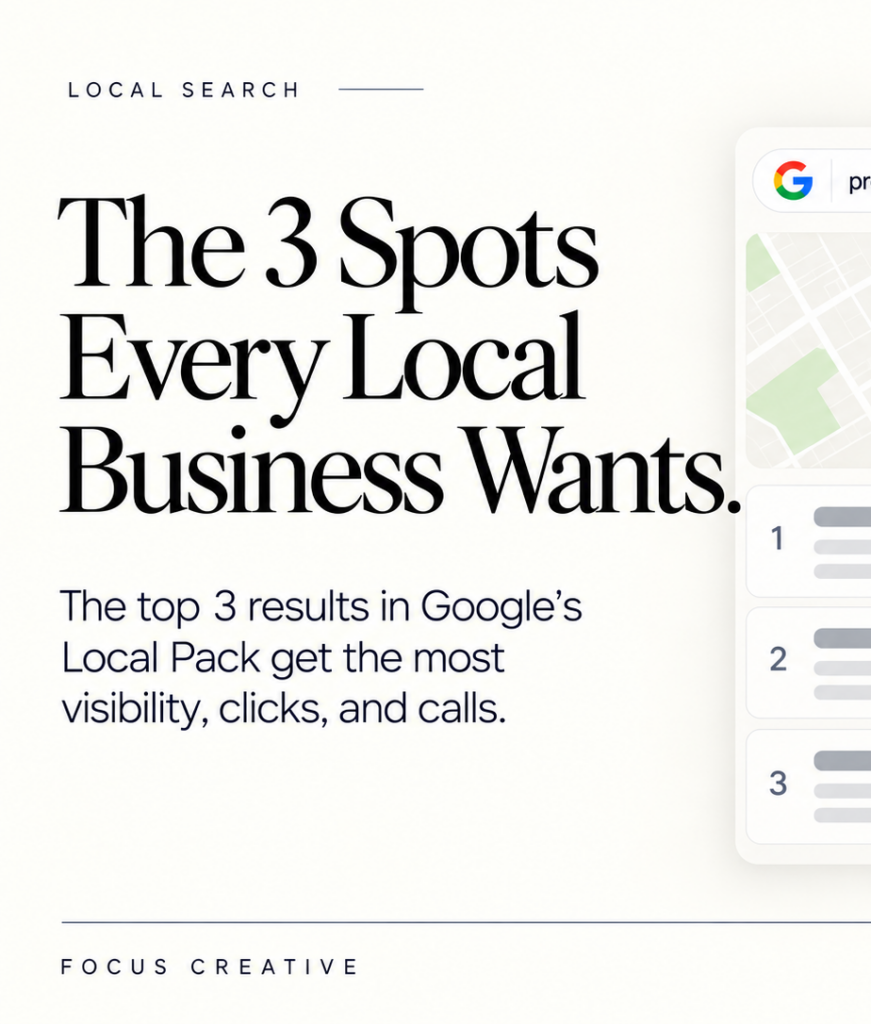
Most Professionals Treat Their Google Listing Like a Directory Entry
When someone mentions “Google listing,” most business owners think about the basics: name, address, phone number, hours. They set it up once – maybe years ago – and assume it’s handled.
But a Google Business Profile isn’t a directory listing. It’s a live, constantly evaluated business signal.
Google is always watching how your profile performs. It tracks whether clients engage with your listing, whether you respond to reviews, whether your information is current and complete, whether you’re adding content, whether other platforms agree with what your profile says.
The businesses that understand this show up at the top of local search results every day. The ones that don’t are simply invisible – and most of them have no idea.
Distance Is Not What Determines Your Local Ranking – And That Changes Everything
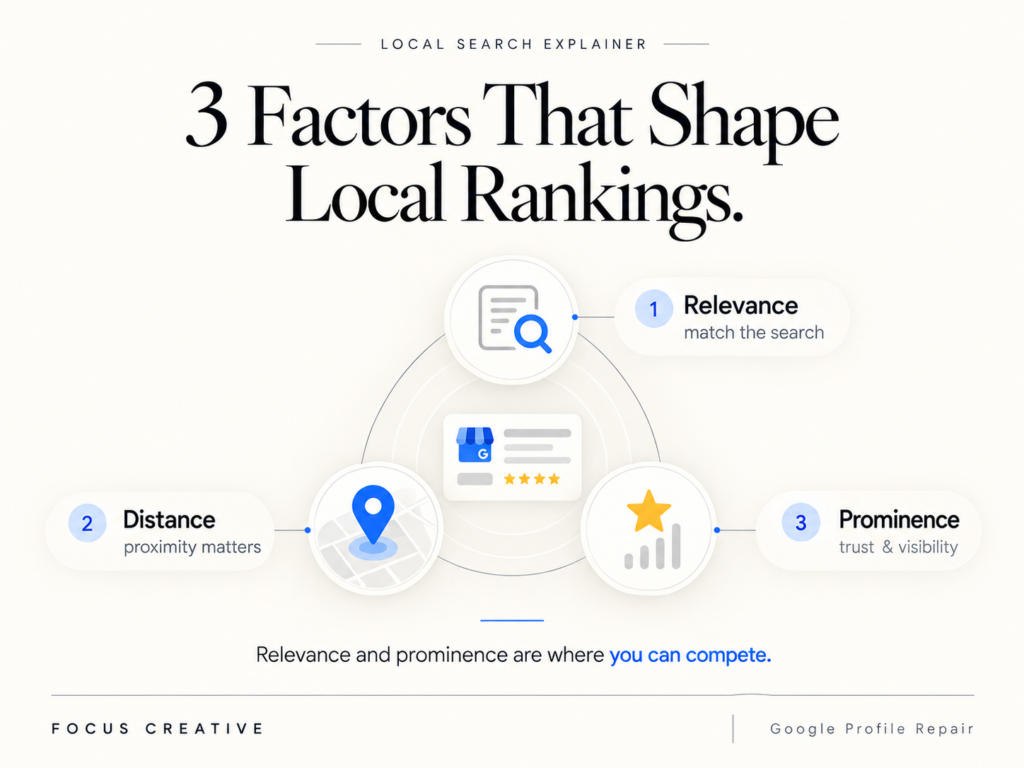
Google’s local ranking algorithm is built on three factors: relevance, distance, and prominence.
Distance is obvious. But here’s where most people make a costly assumption: they think distance is everything, and because they can’t control where their office is located, they assume local rankings aren’t something they can move.
That assumption is quietly costing them clients.
Relevance is entirely within your control. Google determines relevance based on your profile’s content – the categories you’ve selected, the services you’ve listed, the language in your business description, the questions and answers in your Q&A section.
If your profile says “law firm” but a potential client is searching for “estate planning attorney Fairhope AL,” and a competitor’s profile specifically lists estate planning with a description that matches what someone would search – your competitor wins. Regardless of who is physically closer.
Prominence is where it gets even more interesting. Google evaluates how credible and well-known your business appears across the internet – not just on Google. Your reviews, your response rate, how complete your profile is, whether your information is consistent everywhere online.
A 10-year-old, established practice with a neglected profile can be outranked by a two-year-old firm that has treated its Google presence as a priority.
If you’ve never actively managed your profile with these three factors in mind, the odds are strong that your ranking does not reflect your actual reputation – or your actual expertise.
Reviews Are Not Social Proof – They Are a Ranking Mechanism
Here’s something that tends to land differently once you see it clearly:
Reviews on Google are not primarily about what your past clients think. They’re about what Google thinks of you.
The quantity, recency, and consistency of your reviews are direct inputs into your local ranking. A firm with 15 reviews from three years ago is not competing with a firm that has 60 reviews from the last twelve months – even if the older firm is genuinely better at what they do.
Most professional services businesses collect reviews the same way they collect referrals: passively. A satisfied client leaves one occasionally. The practice never actively asks, never has a system for it, and never responds to the ones that come in.
The result is a review profile that tells Google your business is quiet, static, and possibly inactive.
Meanwhile, the competing firm that sends a follow-up message after every appointment, links directly to the Google review page, and responds personally to every review? Google is paying close attention to that signal.
Once you understand reviews as a ranking mechanism rather than social proof, the passive approach stops making sense entirely.
The Information on Your Profile Might Be Contradicting Itself Right Now
There is a lesser-known local search factor that almost never comes up in conversation: consistency.
Google cross-references your business information across every platform it can find – your website, Yelp, Healthgrades, Avvo, Chamber of Commerce listings, old directories, data aggregators. All of it.
If your address appears as “Suite 203-C” on your Google profile, “Ste. 203C” on your website, and “Suite 203” on a directory listing from five years ago, Google registers a discrepancy. It doesn’t know which version is correct. So it hedges – and your local ranking absorbs the uncertainty.
This happens constantly in professional services. A practice moves offices. A firm updates its name. A phone number changes. The Google profile gets updated, but the other twelve places your information lives online do not.
These inconsistencies are silent ranking killers. They are also completely fixable – if you know where to look.
What Most Google Profiles in Professional Services Are Actually Missing
After reviewing Google Business Profiles for law firms, accounting practices, and medical offices, the same gaps appear repeatedly. Not because these businesses are careless, but because nobody ever told them these things mattered.
The categories are set too broadly, missing the specific practice areas that drive relevant searches. The services section is blank or generic, leaving Google to guess what the business actually does. The description reads like a mission statement rather than a search-informed introduction. The photo library has one image from the day the profile was created.
And then there is the Q&A section – one of the most overlooked features on any profile. It is empty on most professional services listings, even though Google can use it to auto-populate answers for people actively searching. That’s your voice, sitting unused, while Google fills in whatever it finds elsewhere.
Any one of these gaps is manageable. But when a profile has all of them – and most do – Google is working with very little to rank that business against competitors who have given it considerably more to work with.
The Question Worth Asking Before Your Competitor Does
Here is what this really comes down to: your Google Business Profile is actively influencing whether potential clients find you or find someone else. Right now. Today.
Not because of how good you are at what you do, but because of how much signal you have given Google to work with.
The question is not whether your profile needs attention. For most professional services businesses that haven’t actively managed it, it does.
The question is what it would mean for your practice if it were fixed.
If your firm appeared in the Local Pack instead of page two. If your profile surfaced for the specific searches your ideal clients are running. If your reviews were recent enough to reassure someone discovering you for the first time.
These are not hypothetical outcomes. They are the result of a profile that has been deliberately built to perform.
Take 15 Minutes to Find Out Exactly Where Your Profile Stands
Google Profile Repair is a done-for-you audit and optimization service built specifically for businesses like law firms, accounting practices, and medical offices who want more local traffic.
We start with a free 15-minute call – no pitch, no pressure. Just a focused look at your current profile and an honest assessment of what’s working, what isn’t, and whether our service is the right fit for where you want to go.
If you read this and found yourself wondering about your own listing, that question is worth answering. See if the Google Profile Repair is right for you.